Cemetery Screenings, one of the best things to do in Los Angeles on a summer Saturday night is nearing the end of its 6th season.
The Hollywood Forever Cemetery is a beautiful stretch of grass and graves, with lush trees, impressive timeworn mausoleums and a gorgeous reflecting pool. It’s dubbed “The Resting Place of Hollywood Immortals” and is home to the remains of of Cecil B. DeMille, Johnny and Dee Dee Ramone, Jayne Mansfield, Rudolph Valentino and many more. Few pastimes are more serene than an afternoon spent wandering around these grounds. The air is clean, the residents are quiet and the staff is fairly invisible. [Unless you decide to conduct a photo shoot without a permit, that is.]
The sky at Hollywood Forever Cemetery before a screening
Since 2002 the fine people of Cinespia have been conducting screenings of old, obscure and cult films, projected onto the side of Valentino’s mausoleum. Hundreds gather at the cemetery gates well in advance to ensure a great spot on the lawn. These lines are a captivating sight: strange caravans of all breeds of Angel City dwellers, their cargo of blankets, lawn chairs, wines and food at hand, to be arranged into picnics once a piece of lawn is secured. The projection begins with a slide show of vintage movie posters as guest DJs spin an eclectic selection of music and the people converge, set up and eat. The first time can be overwhelming, so the Cinespia website offers a few how-to tips for novices.
The three final screenings begin tonight with the Marx Brothers classic Duck Soup, followed by Pee Wee’s Big Adventure next week and culminating with the classic space drama, Alien, on September 20.
Despite being mortally afraid of arachnids, I wish more than anything that I could be there right now to see “La Princesse” coming to life. I’m sure many of you do as well. Is any of our UK readership getting a chance to witness this? Please, drop us a line!
Autumn is upon us, so I’m busting out all of my favorite fall records. First up: anything and everything Jill Tracy has ever touched with her long, thin, alabaster hands.
As can be plainly seen from this gorgeous music video for “Haunted by the Thought of You”, Madame Tracy is one classy dame. Cool as a cucumber. Who else do I know who could maintain such an unflappable air of poise and elegance as reanimated hearts, levitating chairs, creepy humanoid automata, and even the arse of Satan himself loom directly behind her? No one!
Jill Tracy performing live in NYC. Photo by Don Spiro.
I’ve been swooning over the Victorian parlor pianist/netherworld chanteuse ever since a video for her seminal song “The Fine Art of Poisoning” was released a few years back, but she’s been casting her Ghostly Gloom Glam Queen spell for well over a decade (since long before this latest incarnation of the “dark cabaret” movement picked up speed), always with unparalleled grace and sincerity.
The songs collected on her latest album The Bittersweet Constrain(two in particular: “Sell My Soul” and “Torture”) do indeed invoke a delicious sort of pleasure/pain, not unlike the burn of real wormwood absinthe trickling down the gullet; unsettling and exhilarating as receiving a languorous tongue bath from a black cat at midnight on some foggy, windswept moor. Highly recommended.
A few days ago, there was a heated discussion over at copyranter about some new ads which recycle funny student exam answers of the “They Didn’t Study” variety. Meme-tastic scans of such exam answers (“Find X.” “Here it is.”), immortalized by benevolent teachers in public service to the entire Internet long ago, have floated around the web since the Usenet days. In the copyranter thread, some came down on the ad school for “recycling 8-year-old internet jpegs,” while others maintained that all ads repackage old ideas, and that the ads in question did so well.
Stealing old internet memes, that I can forgive. It’s not worth the effort to get all indignant - not when it can be much worse. How bad can it get? Behold! Compare BBDO Athens’ ad for Dexim at the top of this post to an early photo by Jamie Nelson below.
…really? Really?
First of all: BBDO Athens, this is Photoshop Disasters calling. If you’re going to photoshop a model onto a background, at least make sure you get the shadows right. At least Jamie actually put the model on the that background. If you’re going to copy something, at least improve it. The agency lists the photographer, creative director, art director, art buyer, stylist, hair and makeup artist, and photo producer for this shoot. Clayton Cubitt asks, “it takes that many people to rip-off a young photographer’s little editorial shoot?” Why didn’t they just hire Jamie? This is from the same guys who produced that sexist BMW ad, by the way.
It all comes to a full circle so easily on the web. There’s a whole blog devoted to it. How can people think that they won’t get caught, in this day and age?
First, about the website: click here to go to the site of designers Lucy and Bart. Maximize the window. Move your mouse around. Get your face really close to the screen and stare into their eyes. It’s uncanny! Morphing nothing new; we all remember it from a steady stream of 90’s music videos and more recently from the hypnotic Women in Art YouTube spectacle, but this interface manages to make it novel again. Maybe it’s the fact that you can see every pore in the high-res images, the fact that you scan stare into their eyes and manipulate their faces at will, coupled with a flawless, uncomplicated execution. Either way, the simple navigation feels immersive in an unexpected way.
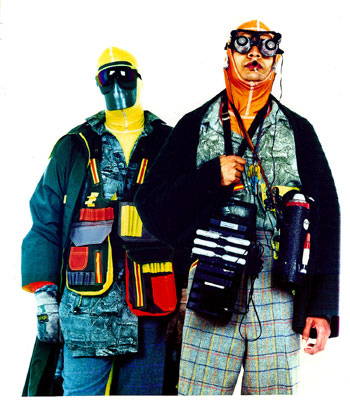
The designers use cheap materials such as cardboard and pantyhose nylon to produce extravagant shapes. While most art clothing made out of bubble wrap, toilet paper and tinsel tends to resemble failed Project Runway challenges, the constructions here contain volume, depth, texture and, importantly, storytelling. The motivations for the designs are explained on the site as “an instinctual stalking of fashion, architecture, performance and the body.” It is stated that designers Lucy McRae and Bart Hess share a fascination with genetic manipulation and beauty expression, and that unconsciously their collaborations touch on these themes, though it was not their intention to communicate this. Their process searches for “low–tech prosthetic ways for human enhancement,” stumbling on new constructions during a creative process that they describe as a primitive, blind search.
Take a look at Cheval Noir [Black Horse] - artist Aya Kato’s portfolio site, especially if you’re familiar with her work. I was just reminded of her by Ashbet and noticed a significant change in her work’s direction. Aya Kato made herself a name with eye-drowning elaborate technicolor illustrations, influenced in equal parts by Ukiyo-e and Art Nouveau. More than half of her 2008 work borders on minimal, with subdued colors and more negative space. After years of churning out ornate psychedelic panels it’s an understandable step for the young artist. It’ll be curious to see whether she’ll push herself even further in this direction.
Spider, 2008
Aya Kato has been featured in countless magazines and her designs adorn everything from chocolate boxes to T-shirts to Hitachi adverts. At such a young age she’s had international success, and I’m eager to see whether her new work’s look will catch on commercially. Compare the image above, created in 2008, to Akazukin, from three years ago, below. Patterns and transformation are featured in both, but the similarities end there. Personally, as much as I love the clean and minimal, I miss the vivid landscapes and superabundance of Aya’s older work.
Another Soviet cartoon awaits below! A favorite in my childhood household, Very Blue Beard was released in 1979 and tells an alternate tale of the famed wife-killer and three of his objets d’amour. This particular version places all the blame directly on the wives and identifies the beard as symbol of male essence, constantly oppressed by scissor-happy women. Nonetheless, the Modigliani-meets-Peter Chung look of the figures and the background treatment are worth a peek. No subtitles, so I’ll summarize below each of the two parts.
Part 1
A modern day detective sets out to learn the truth about Blue Beard upon finding a piece of blue hair. He calls his wife to tell her of this discovery, only to be nagged half to death about the possibility of coming home late. The investigation must continue! Soon Bluebeard is found alive and well, just beyond the borders of alternate reality. [In Soviet Russia, alternate reality can be entered through the subway, by the way.] He admits his guilt but requests the detective’s ear for a chance to explain his reasons.
Blue Beard’s first wife is Marianna, an ultra-modern English fashionista who isn’t interested in Blue’s old-fashioned ways. She redecorates his palace to her own liking, then drives him mad with her weaves and pet dragon. As the rage wells up inside Blue Beard, his beard grows back, signaling that he’s had enough of this free-willed lady!
Sunlight comes only rarely, with a sliver slicing down between the ramshackle towers. The light here is fluorescent and the people packed sardine tight amongst twisting corridors. Some of the lower levels are widely considered uninhabitable due to trash. Up the street (if it can be called that) there’s a drug parlor with an unlicensed “doctor” open for business upstairs. They exist openly: there are no police because there is no law.
The above is not a description of a dystopian (or utopian) fantasia, but of the Kowloon Walled City which was very real. From 1945-1993, a political loophole created a zone of Hong Kong where there was no law. The resulting anarchic, hodge-podge monolith was the descendant of the pirate utopias of old: a testament to humanity’s ingenuity, greed, violence and tenacity. Here is a glimpse within the walls of one of the strangest human settlements ever.
Earlier this summer, Warren Ellis (yes, that one guy we reference every ten minutes on COILHOUSE, shaddup) posted some cogent thoughts on what he describes as the end of “The Patchwork Years” on the internet: “Nobody needs another linkblog… There are already thousands of them. The job of curation is being taken care of. Look ahead.” He’s right. I’m as guilty of rehashing as the next blogger, but yeah. Generally speaking, we could do with far less circle-jerk turd-polishing online.
Paraphrasing the feisty theater renegade Maya Gurantz, those of us in any position to create new media should be baking new bread instead of quibbling over stale crumbs. At the very least, we existing curators should be doing helluva lot more cogitating instead of regurgitating the same tired old ones and zeros. (”Hey dood, check out this awesome link via BoingBoing via Fark via Digg via Shlomo McFluffernutter’s Livejournal feed. Cut, paste, click.”)
More on internet culture’s addiction to shorthand tastemaking at some later date.
Meanwhile, even in these postulated-out, post-patchwork years, it’s still very possible to be galvanized by some vital new curator. Fellow bay area sasspot Whitney Moses emailed me a while back about a blog called Genderfork, run by Sarah Dopp.
Genderfork is an exploration of androgyny and gender variance through artistic photography and personal essays. Dopp has two personal goals for the project:
To compile all of the genderforking resources, imagery, and ideas that I come across on the web into one beautiful repository. I want to experience a sense of cohesion with these concepts — they all too often feel scattered and disparate.
To encourage a conversation around the grey areas of gender with friends, with strangers, and with strangers who need to become friends.
…because I think we can all agree: Gender is a loaded word.
Loaded, and how. That’s why complex arguments revolving around gay marriage and partnership rights can become so volatile so quickly, and why debate rages endlessly on between gender-abolitionist feminists and their less radical sisters. It’s why surprisingly empathetic reportage on 20/20 examining the lives of transgendered children feels like a huge victory, and why my co-editors and I fought tooth and nail to find a way to publish Siege’s Neogender piece in Coilhouse Issue 01, if only in a limited capacity.
Wayne Martin Belger builds pinhole cameras - this much can be said with certainty. The rest becomes as rain-blurred and effervescent as the images his unique apparatuses produce. Pinhole cameras are still popular among hobbyists and are occasionally hailed as the purest photographic tool. With no lenses between the tool and the subject, the scene, the light and the depth of field are captured in smoky stills - as if snapped by the mind’s eye. Experiencing these images for the first time is more like viewing impressions, memories.
As you can see above, WMB’s cameras are beyond mere tools, more than means to an end. While many artists long for the process more than the product, Belger has redefined process-love completely. His projects sometimes plant their seeds through the items he collects, other times through ideas, upon the birth of which collecting begins. The camera he used to photograph AIDS victims is built with a vial of AIDS-infected blood, the one with which he captured the secret life of deer is crowned with antlers, expectant mothers were shot with a camera within which an infant’s heart sits still. He’s used bees, human skulls, religious relics, and more. Each device built by Belger contains its sacred object, each otherworldly photo series is just part of a ritual and carries with it the spirit of the camera, the concept, the execution itself.
Belger and his exquisite cameras can be seen next at Device Gallery on September 13, at a special reception from 6 to 9 pm.